Parker Center
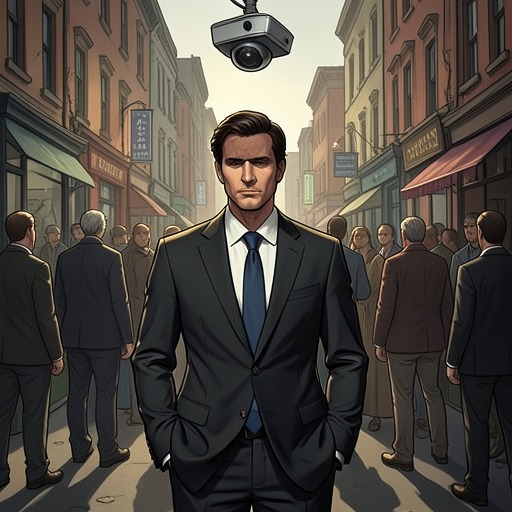
Inherent ViceParker Center, the Los Angeles police headquarters Doc calls the Glass House, is the institutional heart of the LAPD and one of the novel’s most revealing urban interiors. Its plain, almost innocuous exterior conceals a world of police dynasties, secret loyalties, and codes of silence, making the building a physical counterpart to the less visible systems of surveillance and coercion that shape the city. For Doc, visits there mean crossing from the beach’s loose, improvised networks into an institution that claims to protect the public while shielding its own power.
Setting and Appearance
Parker Center first registers in Doc’s imagination as a structure that seems harmless enough: it sits among downtown Los Angeles’s older civic architecture with the unthreatening neutrality of a chain motel. Behind its drapes, however, fluorescent corridors contain an alternative history of policing, populated by heroes and villains, capable and incompetent officers, and inherited loyalties that separate the department from the public it governs. Doc’s unease comes less from the building’s appearance than from the mismatch between that appearance and the systems hidden inside it.
The headquarters also has an ordinary, disorderly working face. At Robbery-Homicide, Bigfoot’s colleagues share a single oversized room rather than individual offices or cubicles. Two long tables, paper cups of coffee, cigarettes, ringing phones, shouted conversations, food orders, and debris scattered across the floor make the department feel at once crowded and careless. The unglamorous workplace complicates the aura of institutional authority: the machinery of policing is not a polished command center, but a noisy office whose informal habits coexist with its consequential reach.
Doc’s Encounters with the Institution
Doc approaches Parker Center reluctantly. After a photograph makes him recognize Coy Harlingen as a police informant, he learns that Coy is associated with the Red Squad and the Public Disorder Intelligence Division. Doc would rather avoid the Glass House, which seems to him a gathering place for secret police histories and loyalties, but his investigation makes a visit to Bigfoot unavoidable. At the lobby desk, he tries to explain his distance from criminal justice, then wanders into talk about the Manson trial and the Lakers. His rambling performance makes the institutional threshold comic without making the institution itself any less imposing.
On another visit, Doc arrives after hearing that Bigfoot may be connected to Vigilant California, the LAPD’s private army of vigilantes, and possibly to the Channel View Estates raid. He has to restrain an angry greeting and instead asks about another case. The contrast between what he thinks and what he says captures the pressure of entering a place where suspicion cannot safely be voiced without consequence. Bigfoot, in turn, invites him to leave the office for a Code 7 meal; they take paperwork in a Ralph’s shopping bag and go to a Japanese restaurant nearby. The movement out of the department briefly makes room for conversation, but it does not remove the police institution from the exchange: Bigfoot brings its work with him.
Police Networks and Political Power
Parker Center is more than a backdrop for individual interviews. The Glass House’s inner world is sustained by loyalties and silences that can protect officers and keep the department insulated from scrutiny. The novel links that institutional culture to the use of informants: Coy’s work for the Red Squad and the Public Disorder Intelligence Division places him inside a system that monitors political activity while disguising the human relationships and costs behind the official label of informant.
The department’s reach also extends beyond its recognized personnel. Adrian Prussia becomes a regular presence around Parker Center, although officers do not always know his name and do not question why he is there. After establishing himself through an elaborate circumstantial-evidence setup and walking away from a case because there is no body, he is drawn into work as a private contractor. He specializes in attacks on political targets, including Black and Chicano activists, antiwar protesters, and campus bombers. His accepted presence at Parker Center gives physical form to a larger arrangement: police power can operate through unofficial agents whose work remains useful even when their status is unacknowledged.
The City Around the Glass House
The meaning of Parker Center is sharpened by the novel’s account of Los Angeles as a city repeatedly remade through displacement. Aunt Reet, whose knowledge of land use reaches from desert to sea, represents a local memory of property histories and the forces that official deeds may not record. Tariq Khalil connects that history to the removal of Japanese residents during the Second World War and the subsequent arrival of Black families in South Central. He sees the bulldozing of his neighborhood for Channel View Estates as another turn in a continuing sequence. The narrative places that development alongside Mexican families displaced from Chavez Ravine for Dodger Stadium and American Indians cleared from Bunker Hill for the Music Center.
This geography also makes the police headquarters part of a wider landscape of contested access and control. Channel View’s streets and houses arise from cleared land; Vigilant California’s armed members boast of defending their patch against Black newcomers; and police-connected figures move among the institutions that authorize or tolerate such force. Parker Center does not itself cause each act of dispossession, but it stands at the center of the police order within which informant work, private violence, and official protection can overlap. The city’s development story and the building’s hidden interior history thus converge: both are shaped by who can claim a place, who is watched, and who is pushed out.
Narrative Significance
The Glass House’s harmless look is a structural irony. Doc can see that its neutral drapes and routine office clutter do not reveal what the institution does; the building’s ordinary surface shelters a world of secret affiliations and internal rules. That contrast makes Parker Center a concentrated image of the novel’s recurring gap between public explanation and concealed operation. The police promise protection, yet Doc encounters a department entangled with informants, vigilante associations, and contractors who attack political targets.
Parker Center also marks a change in Doc’s relation to Bigfoot. Doc once worried about becoming like the diligent detective who follows only the leads in front of him, and he had been willing to give Bigfoot some latitude. The possibility that Bigfoot is connected to a private vigilante force alters that latitude, turning their visits from a familiar, uneasy routine into a test of trust. The Glass House remains a place Doc enters for information, but it also reminds him that information itself is governed by the institution: what can be known, what is concealed, and whose version of events will count as protection.